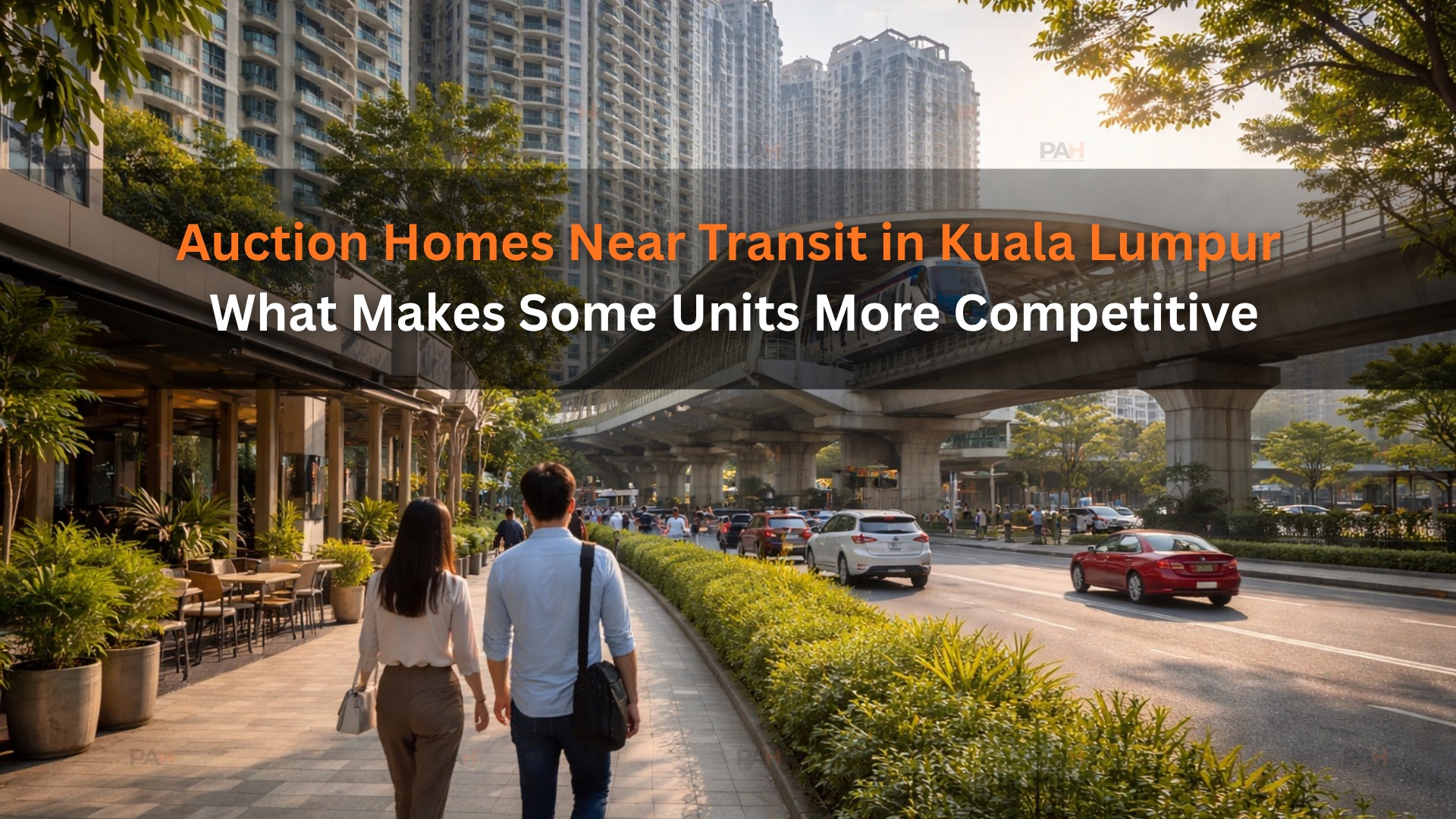
Auction Homes Near Transit in Kuala Lumpur: What Makes Some Units More Competitive
In the congested urban landscape of Kuala Lumpur, proximity to public transportation is the ultimate real estate premium. Properties located near Mass Rapid Transit (MRT), Light Rail Transit (LRT), and Monorail stations—often referred to as Transit-Oriented Developments (TOD)—are fiercely sought after.
When these properties enter the Malaysian auction (Lelong) market, they attract a flood of attention from both seasoned investors and first-time homebuyers. However, not all transit-adjacent properties perform equally at the auction block. Some units trigger aggressive bidding wars, while others languish with no takers.
If you want to secure a highly profitable Lelong property near transit in Kuala Lumpur, you must understand the underlying factors that drive competition. Here is what makes certain units exponentially more valuable than others.
1. The True "Walking Distance" Metric
Real estate brochures frequently use the term "near transit" loosely. In the highly competitive Kuala Lumpur Lelong market, the definition of proximity is strictly literal.
The 500-Meter Radius: Properties located within a genuine 500-meter walking distance (roughly a 5 to 7-minute walk) from an MRT or LRT station command the highest premiums. Investors know these units will rarely suffer from vacancy.
Covered Walkways vs. Open Roads: A property 400 meters away with a dedicated, covered, and brightly lit pedestrian bridge to the station will always outbid a property 300 meters away that requires pedestrians to cross a busy, multi-lane highway or walk through poorly lit areas. Accessibility and safety drastically influence a unit's competitive edge.
2. Rental Yield Potential vs. Target Demographics
Investors flock to transit-oriented Lelong properties specifically for their robust rental yields. The competitiveness of a unit is directly tied to the demographic it can attract.
Interchange Stations: Properties near interchange stations (e.g., KL Sentral, Pasar Seni, Bukit Bintang, Titiwangsa) are the most competitive. They offer tenants access to multiple transit lines, attracting high-paying expatriates, corporate professionals, and university students.
Unit Layout: A dual-key unit or a compact two-bedroom apartment near a transit hub will often see more aggressive bidding than a massive luxury penthouse. Smaller, space-efficient layouts are easier to rent out at higher per-square-foot rates to young urban professionals who prioritize commute times over living space.
3. The Health of the Management and Outstanding Arrears
The physical and financial health of the building heavily dictates auction day competition. Buyers will scrutinize the Conditions of Sale (COS) before raising their paddles.
Maintenance of Facilities: A transit-adjacent condominium with well-maintained elevators, tight security, and clean common areas signifies a strong Joint Management Body (JMB). If the building looks dilapidated, the convenience of the nearby MRT will not save it from low bids.
Outstanding Fees: High-density TODs can accumulate massive outstanding maintenance fees. If the COS states that the assignee bank will not absorb these arrears, bidders will subtract that cost from their maximum bid limit, cooling down the competition significantly.
4. Strata Title Status and Loan Approval Certainty
Because transit-oriented developments are usually high-rise condominiums or serviced apartments, their legal status impacts financing certainty.
Issued Strata Titles: Units with an issued strata title (Non-LACA auctions) are highly competitive because they pose less completion risk to financing banks.
Developer Health: If the strata title has not been issued (LACA auctions) and the master developer is bankrupt or blacklisted, experienced investors will immediately back away. The difficulty in obtaining developer consent to transfer ownership makes securing a 90% housing loan nearly impossible within the strict 90-day deadline.
Elevate Your Investment Strategy with Property Auction House
Navigating the strict deadlines and legalities of the Lelong market can be daunting. As your premier advisor, Property Auction House offers comprehensive consultation to simplify the entire process. Guided by international professional standards, we assist you at every stage—from property curation and bidding strategies to managing complex loan documentation. We ensure your investment journey is secure, seamless, and highly rewarding.
Securing a highly competitive transit-oriented property requires more than just capital; it demands precise, data-driven strategy. Operating strictly on a transparent, we eliminate the unpredictability of traditional commissions. Our objective is to maximize your ROI by conducting rigorous pre-auction due diligence—evaluating true transit accessibility, uncovering hidden arrears, and analyzing title statuses—so you can bid with absolute certainty and zero hidden costs.
Frequently Asked Questions (FAQ)
Q1: Are properties near future/under-construction MRT lines good auction targets?
A: Yes, they offer excellent capital appreciation potential. Bidding on a Lelong property near an under-construction station allows you to acquire the asset below market value before the transit premium is fully priced into the surrounding neighborhood.
Q2: Do transit-oriented auction properties always have high monthly maintenance fees?
A: Often, yes. Because many of these developments are mixed-use (combining residential, retail, and transit integration) or serviced apartments built on commercial land, the maintenance fees and utility rates are typically higher than standard residential condominiums. You must factor this into your ROI calculations.
Q3: Is it harder to get a loan for a Lelong property located right next to a train track?
A: Not necessarily harder, but the bank's valuer will take the noise pollution into account. If the unit faces the tracks directly and suffers from severe noise, the official Valuation Price may come in lower than a quieter unit facing the opposite direction, potentially causing a valuation gap.
Q4: Will the bank finance the purchase if the TOD unit is categorized as commercial (e.g., SOHO/SOVO)?
A: Yes, but the Margin of Financing (MOF) may differ. While standard residential homes can get up to 90% MOF, some banks limit commercial-titled units (like SOVOs or SOFOs) to 80% or 85% MOF. Furthermore, commercial units are subject to different utility tariffs and quit rent rates.
Looking for auction homes near transit in Kuala Lumpur? Learn what makes MRT/LRT Lelong properties competitive, how to assess rental yields, and secure your BMV investment safely with our fixed-fee experts.