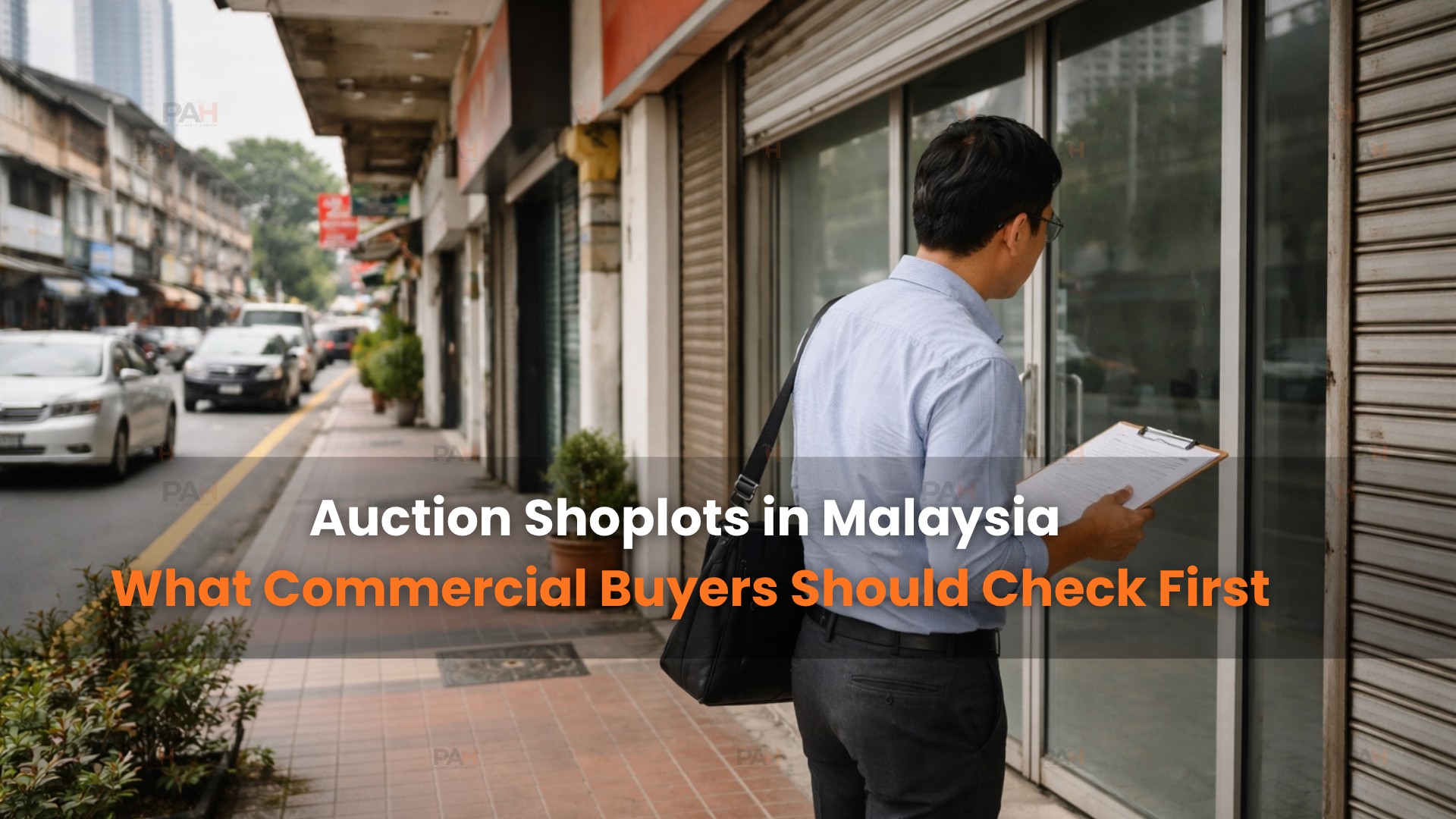
Auction Shoplots in Malaysia: What Commercial Buyers Should Check First
For ambitious investors and Small and Medium Enterprises (SMEs) in Malaysia, expanding a brick-and-mortar footprint through the auction (Lelong) market is a highly lucrative strategy. Acquiring a commercial shoplot at a staggering Below Market Value (BMV) discount provides immediate equity and opens the door to exceptional, long-term rental yields.
However, buying commercial real estate is a vastly different arena than purchasing a residential home. The financial liabilities are heavier, the banking regulations are stricter, and the legal constraints are unforgiving. If you are targeting an auction shoplot, here are the critical checks you must perform before raising your bidding paddle.
1. Corporate Purchasing Power and Documentation
When buying an auction shoplot under an SME, you are not bidding as an individual; your company (typically a Sendirian Berhad or Sdn Bhd) is the legal entity acquiring the asset.
Constitution / M&A Verification: You must ensure that your company’s Memorandum and Articles of Association (M&A) or Constitution explicitly authorizes the company to purchase and hold real estate.
Board Resolutions: Before the auction day, the Board of Directors must pass a formal resolution authorizing the purchase of the specific Lelong property and appointing an authorized representative to bid and sign the Memorandum of Sale (MOS) on the company's behalf.
Director Guarantors: Because SMEs are separate legal entities, commercial banks will almost universally require the company directors to act as personal guarantors for the commercial property loan.
2. Margin of Financing (MOF) and Cash Liquidity
The financial entry barrier for commercial properties is significantly higher than for residential homes.
Lower Loan Margins: While residential buyers can often secure a 90% Margin of Financing (MOF), commercial loans for SMEs typically max out at 80% to 85%.
The Valuation Gap Risk: Just like residential Lelongs, the bank will base this 80-85% loan on the lower of the Successful Bid Price or the Valuation Price. Because commercial shoplots are high-value assets, a valuation gap requires massive liquid cash reserves—often up to 20% to 30% of the property value—to cover the initial 10% bank draft and the wider financing shortfall.
3. The Crushing Weight of Commercial Arrears
The "as is where is" clause of the Lelong market is particularly dangerous in the commercial sector.
Commercial Utility Rates: Previous owners of bankrupt businesses often leave behind massive utility debts. Because commercial Tenaga Nasional Berhad (TNB) and Indah Water Konsortium (IWK) rates are much higher than residential rates, these arrears can easily run into tens or hundreds of thousands of Ringgit.
Reviewing the COS: You must scrutinize the Conditions of Sale (COS). If the assignee bank refuses to absorb these massive commercial arrears, the financial burden falls entirely on your SME. You must clear these debts in cash before utility providers will reconnect your services or the title can be legally transferred.
4. Zoning and Express Conditions (Syarat Nyata)
Do not assume that because a property looks like a retail shop, you can run any type of business out of it.
Local Council Restrictions: You must check the express conditions (Syarat Nyata) on the land title and the zoning regulations of the local municipal council. If you buy a shoplot zoned strictly for retail but intend to use it for light manufacturing, packaging, or a centralized cloud kitchen, the local council will deny your business license.
Strata Shoplots: If the shoplot is part of a stratified mall or mixed development, the Joint Management Body (JMB) may have strict house rules restricting certain types of businesses (e.g., no heavy cooking or F&B operations without specialized exhaust systems).
Secure Your Corporate Asset with Property Auction House
Commercial real estate acquisitions require airtight corporate strategy and meticulous legal foresight. A single miscalculation can trap your business capital and trigger a catastrophic deposit forfeiture.
Navigating the strict deadlines and legalities of the Lelong market can be daunting. As your premier advisor, Property Auction House offers comprehensive consultation to simplify the entire process. Guided by international professional standards, we assist you at every stage—from property curation and bidding strategies to managing complex loan documentation. We ensure your investment journey is secure, seamless, and highly rewarding.
Operating exclusively on a highly transparent, fixed-fee consultation model, we eliminate the conflict of interest found in traditional, commission-based commercial real estate brokering. Our expert team conducts rigorous commercial due diligence—verifying zoning laws, forecasting corporate loan margins, and uncovering hidden arrears—so your SME can acquire prime commercial assets with absolute strategic certainty.
Frequently Asked Questions (FAQ)
Q1: Can an SME use the purchased auction shoplot for rental income instead of its own operations?
A: Yes. Many SMEs acquire commercial Lelong properties purely as investment vehicles. Securing a reliable corporate tenant for the shoplot provides the SME with a steady stream of passive income and long-term capital appreciation on its balance sheet.
Q2: Will banks finance an auction shoplot if my SME is less than two years old?
A: It is very difficult. Commercial banks generally require an SME to have at least 2 to 3 years of audited financial statements proving consistent profitability before they will approve a commercial property loan. Newer SMEs may need to purchase the property under the director's personal name instead.
Q3: Do the 90 or 120-day settlement deadlines apply to commercial shoplots?
A: Yes, the strict legal timeline of 90 days (for LACA auctions) and 120 days (for Non-LACA High Court auctions) applies universally across both residential and commercial Lelong properties in Malaysia.
Q4: Can I inspect the inside of the shoplot before the auction?
A: No. Auction properties are strictly sold "as is where is," and trespassing is illegal. You must conduct an external site visit, evaluate the foot traffic, and check the overall structural integrity of the building from the outside before placing your bid.
Discover how to safely buy auction shoplots in Malaysia. Learn about corporate Lelong purchases, commercial loans, hidden TNB arrears, and secure your asset with our fixed-fee consultation.