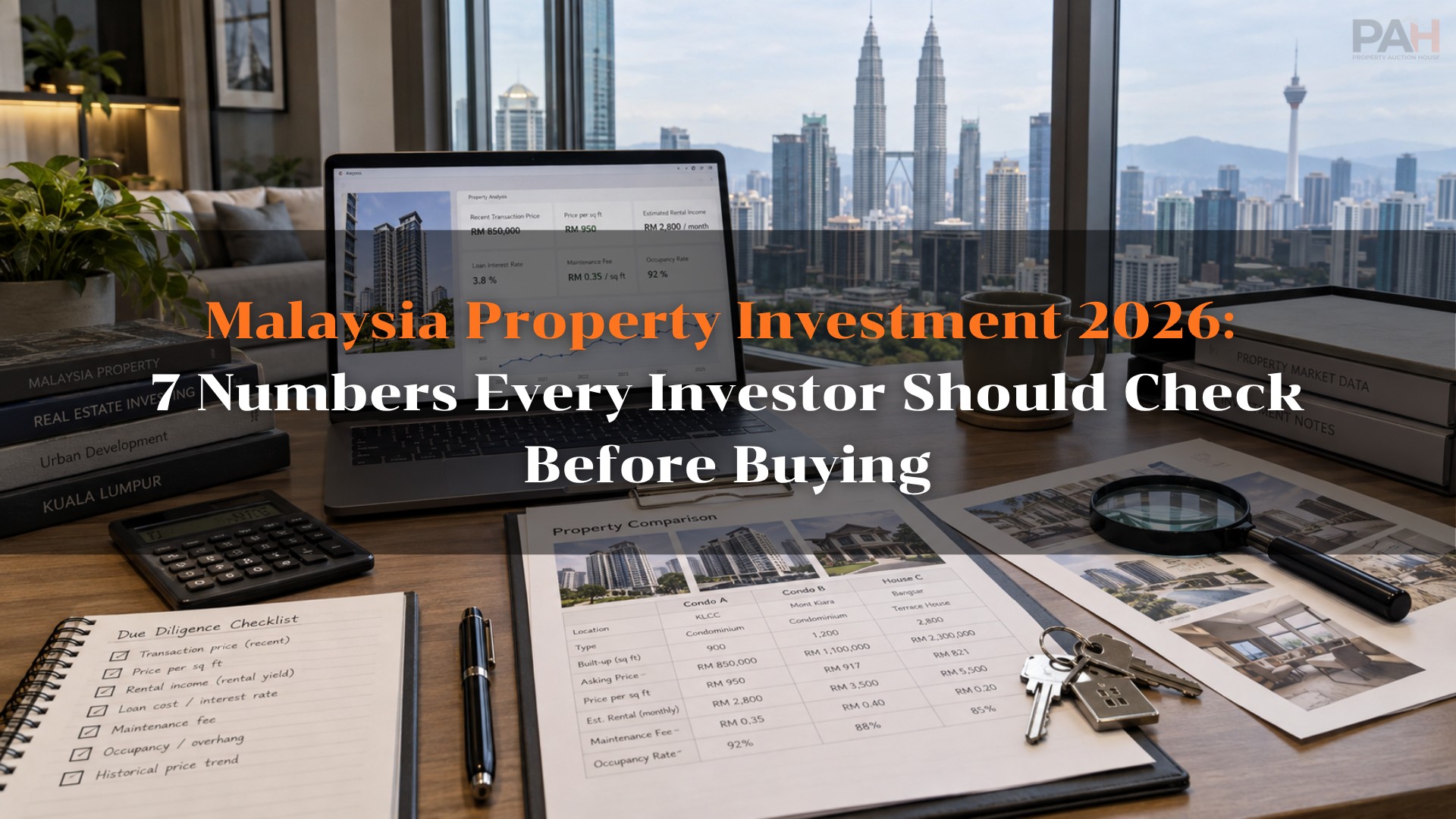
Malaysia Property Investment 2026:
7 Numbers Every Investor Should Check
Before Buying
7 key numbers to help investors compare price, cost, rental return, supply and resale potential before buying property in Malaysia.
Property investment should not begin with one question: “Is this property cheap?” A better question is: “Does this property still make financial sense at this price?”
Before buying an investment property, check these seven numbers.
1. Actual Transaction Price
The first number to check is the actual transaction price of comparable properties, not just the asking prices shown in listings.
For example, nearby properties may be advertised at RM600,000, while similar units may actually transact at only RM530,000–RM550,000. In that case, a property offered at RM570,000 may not be as cheap as it first appears.
Comparable properties should be similar in terms of location, property type, size, tenure, condition and transaction date.
Key principle: Use actual transactions, not just asking prices.
2. Price per Square Foot
Price per square foot, or PSF, is a useful way to compare properties of different sizes.
Property Price ÷ Built-up Area = PSF
For example, a property priced at RM500,000 with a built-up area of 1,000 sq ft has a price of RM500 PSF.
However, PSF should not be used alone. Floor level, view, layout, condition and tenure can all affect value.
Use PSF as a comparison tool, not as the only measure of Market Value.
3. Total Acquisition Cost
The purchase price is not the full cost of an investment.
Purchase Price + Stamp Duty + Legal Costs + Financing Costs + Renovation Costs + Outstanding Costs + Holding Costs = Total Acquisition Cost
For example, a property may cost RM500,000, but after renovation, legal costs and other expenses, the Total Acquisition Cost may reach RM550,000.
Investment returns should therefore be assessed using the total amount invested, not just the purchase price.
The purchase price is only the beginning.
4. Rental Yield
If the property is intended for rental, calculate its Rental Yield.
A simple Gross Rental Yield formula is:
Annual Rental Income ÷ Purchase Price × 100
If monthly rent is RM2,000, annual rental income is RM24,000. On a RM500,000 property, the Gross Rental Yield is 4.8%.
However, Gross Rental Yield does not include costs such as maintenance, vacancy, repairs, management fees and insurance.
Investors should therefore consider both Gross Rental Yield and Net Rental Return.
5. Monthly Cash Flow
Rental Yield shows return as a percentage, while Monthly Cash Flow shows how much money is actually left each month.
Rental Income − Loan Payment − Maintenance − Management Costs − Other Monthly Costs = Monthly Cash Flow
For example, if rental income is RM2,300 and monthly expenses total RM2,050, the property generates RM250 Positive Cash Flow.
If expenses exceed rental income, the property produces Negative Cash Flow.
A good Rental Yield does not always mean good Cash Flow.
6. Existing and Future Supply
Investors should also check how many competing properties are already in the market and how many more are coming.
Look at both Existing Supply and Future Supply.
An area may have strong rental demand today, but if thousands of new units are completed over the next two or three years, this could increase rental competition, extend vacancy periods and create more competition when reselling.
Good demand today does not guarantee good demand tomorrow.
7. Maximum Purchase Price
Before buying, investors should determine the highest price they are willing to pay.
A simple framework is:
Market Value − Expected Costs − Safety Margin = Maximum Purchase Price
For example:
Market Value = RM550,000
Expected Costs = RM30,000
Safety Margin = RM40,000
Maximum Purchase Price = RM480,000
If the seller wants RM530,000, the property may still be a good property — but it may not be a good investment at that price.
What About Auction Property?
These seven numbers are especially important for Auction Property.
Do not use the Reserve Price alone to decide whether a property is cheap.
Before bidding, calculate:
Winning Bid + Legal Costs + Financing Costs + Renovation Costs + Outstanding Costs + Holding Costs = Total Acquisition Cost
Then compare the result with Actual Market Value, Rental Potential and Resale Demand, and set a Maximum Bid Price before the auction begins.
The objective is not simply to win the auction, but to:
Win at a price that still makes financial sense.
7 Numbers at a Glance
1. Actual Transaction Price — What are comparable properties actually selling for?
2. Price per sq ft — Is the price reasonable compared with similar properties?
3. Total Acquisition Cost — How much will you actually spend in total?
4. Rental Yield — What return can the rental income generate?
5. Monthly Cash Flow — How much money remains after monthly expenses?
6. Existing + Future Supply — How much competition exists now and in the future?
7. Maximum Purchase Price — What is the highest price that still makes financial sense?
Conclusion
A good investment cannot be judged by one number alone. A property may be cheap but difficult to rent, offer a high Rental Yield but face rising supply, or be in a good location but purchased at too high a price.
Investors should consider Price + Cost + Rental + Cash Flow + Supply + Resale Potential together and ultimately answer one question:
What is the right price to buy this property?
Because good property investing is not about buying the cheapest property. It is about:
Buying the right property, in the right location, at the right price.
Frequently Asked Questions
1. What should investors check first?
Start with the Actual Transaction Price of comparable properties before relying on asking prices.
2. Is a high Rental Yield always good?
Not necessarily. Vacancy, maintenance, financing costs and other expenses should also be considered.
3. Why is Total Acquisition Cost important?
Because the purchase price excludes costs such as stamp duty, legal fees, financing, renovation and holding costs.
4. Why should investors check Future Supply?
New supply can increase competition in both the rental and resale markets.
5. What should auction investors set before bidding?
Set a Maximum Bid Price based on Market Value, Expected Costs and a Safety Margin before the auction begins.